
Calcium Hydroxylapatite (CaHA): How the Biostimulator Works
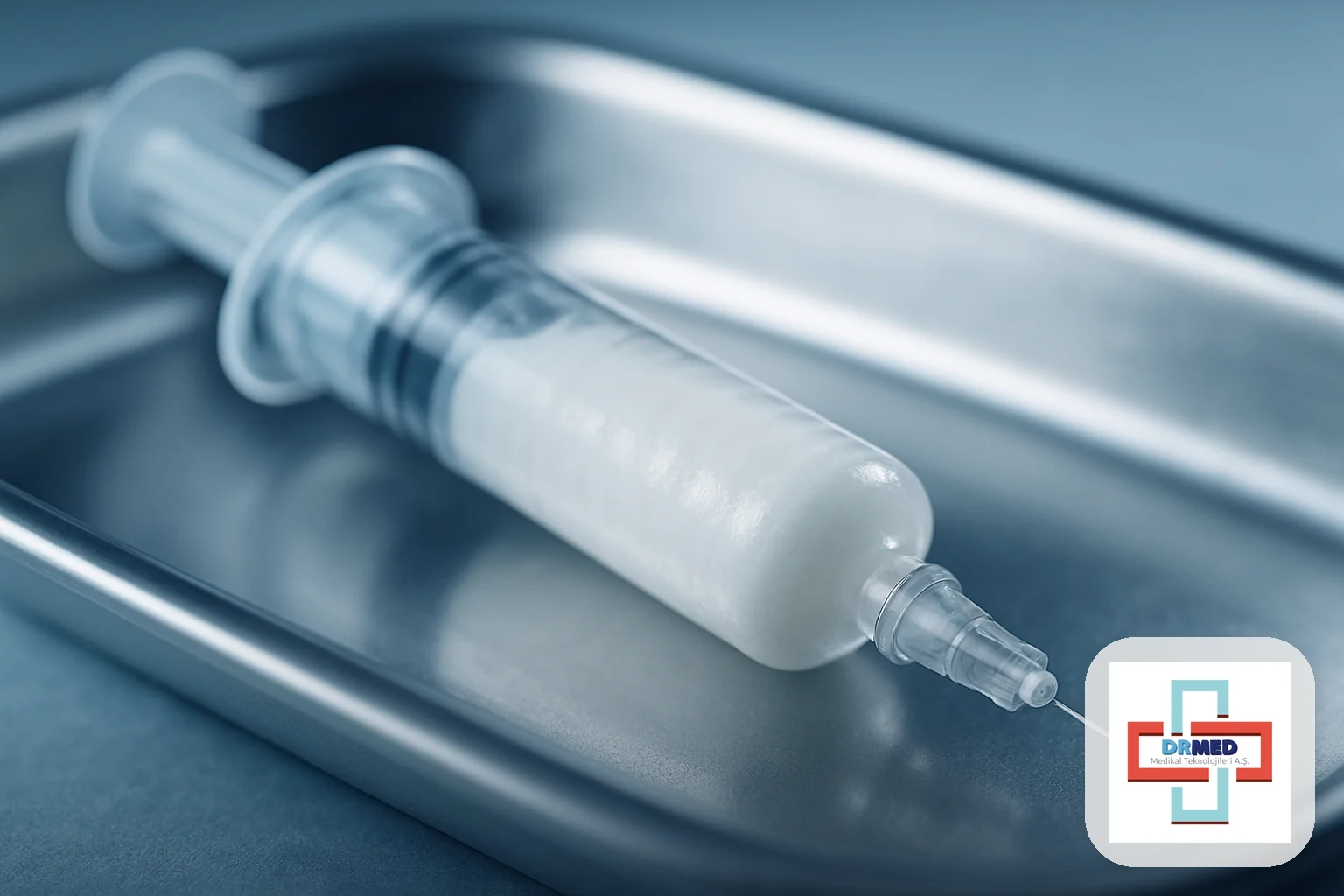
Calcium hydroxylapatite (CaHA) occupies a distinctive place among injectable biostimulators: it behaves like a filler on the day of treatment and like a collagen stimulator in the months that follow. For distributors and clinics building an injectables portfolio, understanding why CaHA behaves this way (not just that it does) is what separates informed product selection from guesswork.
What CaHA Is: A Mineral-Gel Composite
Calcium hydroxylapatite is a synthetic, biocompatible mineral compound chemically similar to the mineral component of human bone and teeth. In injectable form it is not delivered as a raw powder; it is suspended as microspheres within a carboxymethylcellulose (CMC) gel carrier. This composite structure (mineral particles distributed through a viscous gel) is the basis for CaHA's characteristic two-phase behavior.
Immediate Volume: The Role of the Carrier Gel
On the day of injection, the CMC gel provides immediate, physical volume in much the same way a hyaluronic-acid filler does. The suspension has measurable viscosity and elastic modulus, giving the clinician a workable, moldable product at the point of placement. This immediate-volume phase is what allows CaHA to correct contour or volume loss instantly, before any biological response has had time to occur.
The Collagen Response: How Stimulation Happens
Over the following weeks, the CMC carrier gel is gradually resorbed and cleared by the body, while the calcium hydroxylapatite microspheres remain in the tissue. Their presence provokes a controlled fibroblastic response: local fibroblasts are recruited to the microsphere surfaces and begin depositing type I collagen. This is generally described as a foreign-body-adjacent tissue response rather than an acute inflammatory reaction, and it unfolds gradually rather than all at once. Over subsequent months, the microspheres are slowly metabolized into calcium and phosphate ions and cleared through normal physiological pathways, leaving newly formed collagen in their place, the mechanism behind the gradual "skin quality" improvement associated with this category.
Particle Size, Safety Profile and Biocompatibility
The clinical behavior of CaHA is closely tied to microsphere size, typically in the tens-of-micron range. Particles in this band are large enough to resist rapid phagocytic clearance (supporting a sustained collagen-stimulating window) while remaining small enough for smooth extrusion through fine needles or cannulas. Because the base mineral is chemically similar to natural bone mineral, CaHA has an established biocompatibility profile in the literature, though as with any biostimulator, injection depth, dilution and anatomical plane still govern how predictably the tissue response develops in a given case.
How CaHA Fits Alongside Other Biostimulators
| Property | CaHA | PLLA | |---|---|---| | Immediate volume | Yes (from carrier gel) | Minimal to none | | Collagen response onset | Weeks | Weeks to months | | Carrier | CMC gel | Reconstituted suspension | | Typical use pattern | Single or few sessions | Series of sessions |
Both categories rely on a foreign-body-adjacent fibroblastic response, but the carrier chemistry and particle characteristics of each determine the onset, session pattern and handling a clinician should expect.
The Takeaway
CaHA is best understood not as "a filler" or "a stimulator" in isolation, but as both, sequenced by the material science of its carrier and its mineral core. For procurement and clinical teams, this two-phase mechanism explains observed product behavior, immediate contour correction followed by a gradual collagen-driven effect, and underscores why product selection should be guided by mechanism rather than marketing shorthand.
This article is educational and does not constitute medical advice. Product selection, dosing and administration must always be performed by a qualified healthcare professional.