
Poly-L-Lactic Acid (PLLA): The Gradual Collagen Builder
Poly-L-lactic acid (PLLA) is often grouped with dermal fillers in casual conversation, but its mechanism, timeline and handling requirements place it in a distinct category: a collagen biostimulator rather than a volumizer. For distributors and clinics building a biostimulator line, the practical differences (how the product is prepared, how it behaves over time, and what "results" actually means for this category) are worth understanding on their own terms.
What PLLA Is
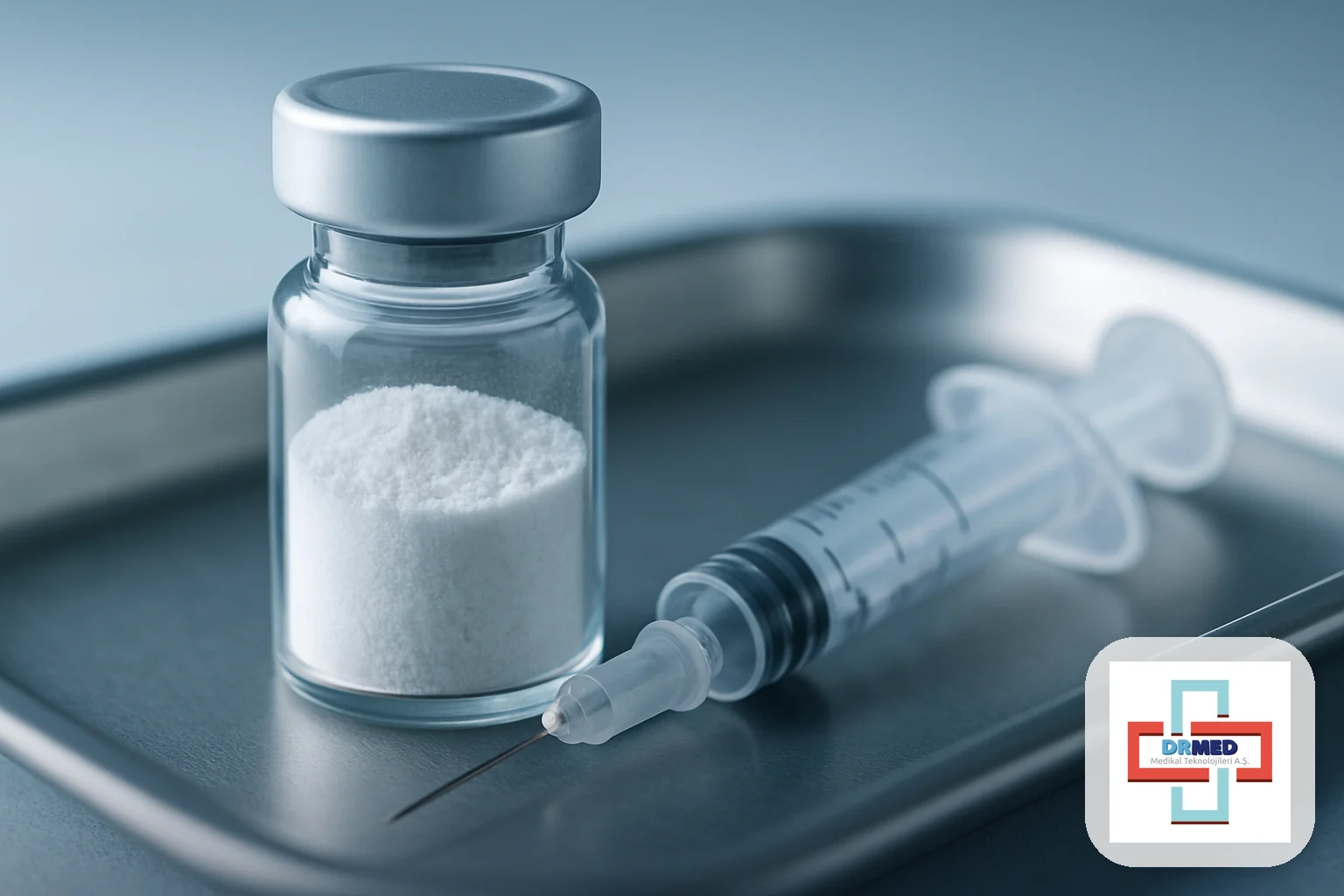
Poly-L-lactic acid is a synthetic, biocompatible and bioresorbable polymer, chemically related to materials that have been used in absorbable sutures and other medical devices for decades. It is supplied as a freeze-dried (lyophilized) powder in a vial, not a ready-to-use gel. This is the first structural difference from an HA filler or CaHA: PLLA must be reconstituted with a diluent before it can be used, and manufacturers specify a recommended reconstitution volume and standing time to allow the microparticles to fully hydrate into an even suspension.
No Immediate Volume, By Design
Because PLLA is delivered as a suspension of microparticles in a mostly aqueous carrier rather than a viscous gel, it does not provide the kind of instant, mechanical volume associated with HA fillers. Any visible fullness immediately after injection is largely attributable to the injected fluid volume itself and typically resolves within days. This is an expected characteristic of the category, not a shortcoming; PLLA is formulated to work through a biological response that develops over weeks to months, not through physical bulk.
The Collagen Response: A Slower Mechanism
Once in the tissue, PLLA microparticles provoke a controlled, foreign-body-adjacent tissue response. Fibroblasts are recruited to the particle surfaces and gradually lay down type I and type III collagen, while the polymer itself is slowly hydrolyzed into lactic acid and cleared through normal metabolic pathways over a period generally described in the literature as many months. Because this is a cumulative biological process rather than a single event, the visible effect of PLLA typically builds gradually and is associated with a series of treatment sessions spaced weeks apart, rather than a single visit.
Why Reconstitution Protocol Matters
Formulation science, not clinical technique, is what determines how a PLLA suspension performs once injected, and reconstitution is where that science is most visible to the end user. Under-diluted or unevenly hydrated suspensions have been associated in the literature with a higher likelihood of visible or palpable nodules, because insufficiently dispersed particles can clump rather than distribute. This is one reason manufacturer-specified reconstitution volumes and standing times exist, and why product training for this category emphasizes preparation as heavily as injection itself.
PLLA Alongside Other Biostimulators
| Property | PLLA | CaHA | |---|---|---| | Presentation | Lyophilized powder, reconstituted | Ready-to-use gel suspension | | Immediate volume | Minimal to none | Yes (from carrier gel) | | Collagen response onset | Weeks to months | Weeks | | Typical use pattern | Series of sessions | Single or few sessions | | Collagen type stimulated | Type I and III | Predominantly type I |
Both categories share the same underlying biological principle (a foreign-body-adjacent fibroblastic response) but differ meaningfully in presentation, onset and the number of sessions a treatment plan typically involves.
The Takeaway
PLLA rewards a longer-horizon view than volumizing fillers: no immediate correction, a gradual and cumulative collagen response, and a formulation that depends heavily on correct reconstitution before it ever reaches the patient. For procurement and clinical teams evaluating this category, the manufacturer's reconstitution guidance, particle-size consistency and stability data are more informative than any single before/after comparison. They are what determine how predictably the biological response unfolds.
This article is educational and does not constitute medical advice. Product selection, dosing and administration must always be performed by a qualified healthcare professional.